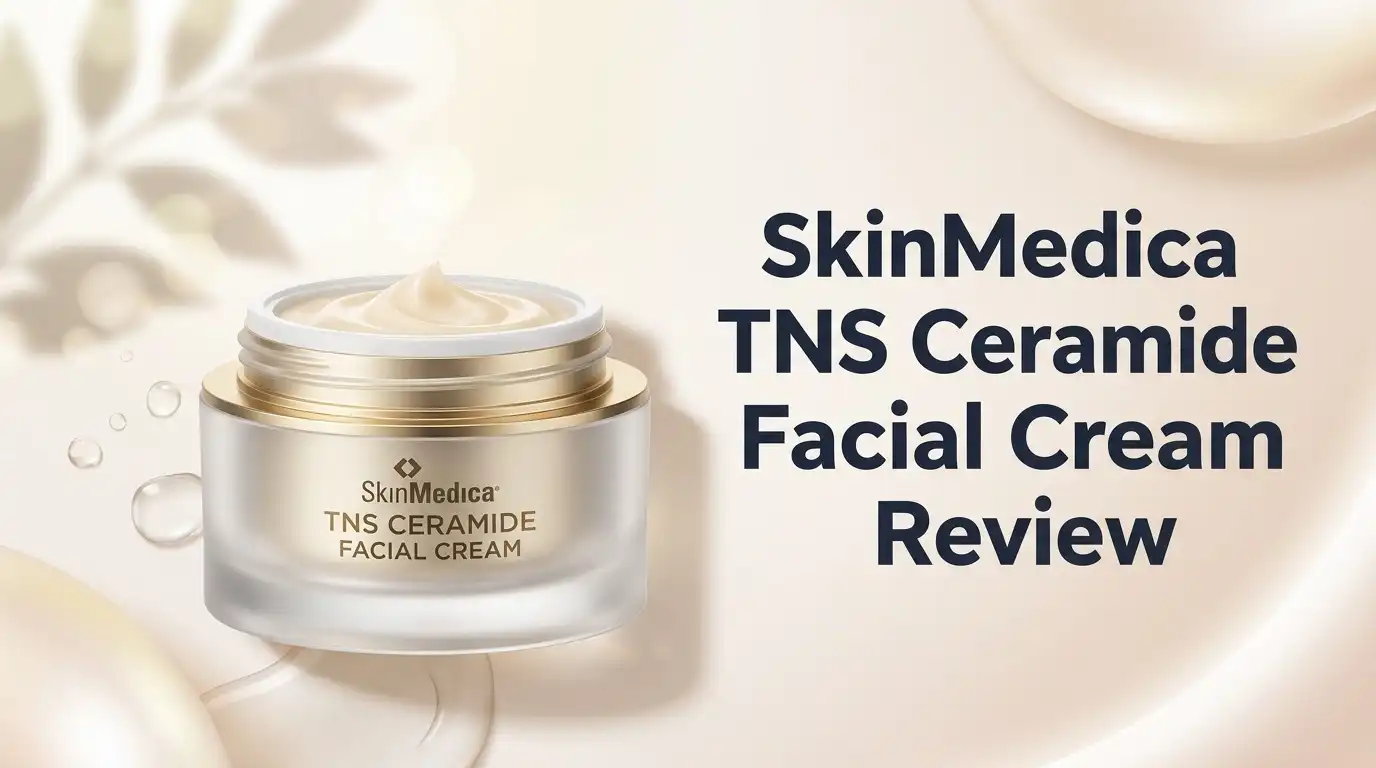
SkinMedica TNS Ceramide Facial Cream Review 2026
Dry skin has a way of ruining a good morning. You wash your face, you pat it dry, and by the time you reach for makeup your cheeks already feel tight.
That tight feeling is what pushed me toward SkinMedica TNS Ceramide Treatment Cream, a rich moisturizer that sits in the premium tier of dermatologist shelves and medspa counters.
This cream carries a $72 price tag for a 2 ounce jar. That number alone makes most people pause. Is a ceramide cream really worth three times the cost of a drugstore tub? I used it every night for eight weeks, tracked how my skin responded, and compared it against three popular rivals.
In a Nutshell:
- The formula is barrier focused first, anti aging second. Hydroxypropyl Bispalmitamide MEA acts as a ceramide substitute, while squalane, glycerin, and sodium hyaluronate handle hydration. Peptides and a stabilized vitamin C sit lower in the list, so treat those as a bonus rather than the main event.
- Texture leans thick and slightly occlusive. Several long term users describe it as a night cream rather than a daytime lotion. It absorbs faster than you expect for its weight, but it leaves a soft cushion on the skin.
- Post procedure skin is the sweet spot. People recovering from microneedling, lasers, chemical peels, or a rough retinoid adjustment period report the biggest wins. If your barrier is intact and happy, the effect feels far less dramatic.
- Price is the biggest complaint. At $72 for 2 ounces, the cost per use climbs quickly if you also apply it to your neck.
- Not every skin type loves it. Combination and oily users on forums often call it too heavy, and a few say it did not feel hydrating enough despite the thickness. Acne prone readers should patch test.
- It contains human fibroblast conditioned media and retinyl palmitate. Pregnant users and anyone with a skin cancer history should ask a dermatologist first.
What Is SkinMedica TNS Ceramide Treatment Cream?

- Helps in restoring your skin's barrier function and balance
- Works well on dry or post-procedure skin

Last update on 2026-08-30 / Affiliate links / Images from Amazon Product Advertising API Some of the links on this website are affiliate links, which means that at no additional cost to you, I earn a commission if you click through and make a purchase. I only recommend products and services that I believe will add value to my readers. Thank you for your support!
SkinMedica sits under the Allergan Aesthetics umbrella, the same company behind Botox and Juvederm. That medical background shapes how the brand sells this cream. It positions the product as a treatment step, not a basic moisturizer.
The full name is TNS Ceramide Treatment Cream. TNS stands for Tissue Nutrient Solution, the brand’s growth factor blend built from human fibroblast conditioned media. That same technology powers the famous TNS Advanced+ Serum, which is the product most people know SkinMedica for.
The cream targets three jobs at once. It replaces lipids that dry or damaged skin has lost. It seals in water so your skin stops leaking moisture through the day. And it delivers supporting actives like peptides and antioxidants while the barrier rebuilds.
Aestheticians hand this jar to clients after procedures for a reason. Freshly treated skin loses water fast, and a lipid rich cream slows that loss. The formula skips fragrance, parabens, and sulfates, which lowers the odds of stinging on raw skin.
The jar holds 2 fluid ounces, or 59 milliliters. That is a standard size for luxury moisturizers, though the packaging looks bigger than the contents suggest. SkinMedica classifies this as a cosmetic product, so the claims are cosmetic claims, not drug claims approved by the FDA.
Unboxing Experience and First Impressions
The box arrived in plain protective packaging with no frills. SkinMedica keeps its outer carton simple: white background, clean sans serif type, a small teal accent. It looks clinical rather than luxurious, which honestly matches the brand personality.
Inside sits a frosted white jar with a heavy screw top lid. The jar feels substantial in your hand. There is real weight to it, the kind that makes a $72 purchase feel slightly less painful. A thin plastic seal covers the opening, and a small white spatula is not included, which surprised me at this price point.
Peel the seal back and you meet a smooth, matte, ivory cream. It looks like thick cake frosting and holds a peak when you scoop it. The surface stays undisturbed rather than slumping, which tells you the emulsion is dense.
The smell is the first pleasant surprise. There is no added fragrance, and the base scent is faint and slightly waxy from the fatty alcohols. It fades within seconds of application.
My first finger dip taught me the golden rule with this cream. Take less than you think you need. A pea size amount covers the entire face. My first attempt used roughly double that, and I spent two minutes patting away the excess into my neck and jawline.
Ingredients That Do the Heavy Lifting
The label runs 36 ingredients deep, but only a handful drive results. Let me break down the ones that matter.
Hydroxypropyl Bispalmitamide MEA appears fourth on the list, which is a high placement. This is a synthetic ceramide analog built to mimic Ceramide 3. Technically it is not a true ceramide because it lacks the sphingosine structure, but it performs a similar job of reinforcing the lipid matrix.
Human Neonatal Fibroblast Conditioned Media sits fifth. These are growth factor proteins that signal skin cells to repair and produce collagen. Studies on conditioned media show measurable improvement in photodamaged skin over 24 weeks, backed by biopsy data rather than flattering photos.
The supporting cast is genuinely well chosen. Squalane, olive fruit oil, and soybean oil supply emollient lipids. Glycerin, panthenol, and sodium hyaluronate pull water into the surface layers. Allantoin, bisabolol, and oat kernel extract calm irritation, which explains why post procedure skin tolerates it.
Two actives deserve a caution flag. Retinyl palmitate is a weak retinoid ester, gentle but present. Tetrahexyldecyl ascorbate is an oil soluble vitamin C that supports antioxidant defense. Neither appears at treatment strength, so do not buy this expecting retinol or vitamin C results.
The formula is fragrance free, alcohol free, paraben free, and vegan. It is not fungal acne safe due to the fatty alcohols and plant oils.
Top 3 Alternative for SkinMedica TNS Ceramide Facial Cream

- PATENTED LIPID RATIO: Contains optimal 2:4:2 ratio of 2% pure ceramides 1 and 3, 4% natural cholesterol, and 2% fatty acids proven to nourish skin and correct signs of aging
- BARRIER RESTORATION: First cholesterol-dominant ratio formula helps restore skin's external barrier and support natural self-repair
Last update on 2026-08-30 / Affiliate links / Images from Amazon Product Advertising API Some of the links on this website are affiliate links, which means that at no additional cost to you, I earn a commission if you click through and make a purchase. I only recommend products and services that I believe will add value to my readers. Thank you for your support!
SkinCeuticals Triple Lipid Restore 2:4:2

- CLINICALLY PROVEN TO IMPROVE DRY SKIN: EltaMD Barrier Renewal Complex Facial Moisturizer is clinically proven to visibly improve dry, compromised skin after a single application within 24 hours*
- RESTORES MOISTURE AND STRENGTHENS SKIN BARRIER: EltaMD Barrier Renewal Complex Face Moisturizer is formulated with ceramides and essential lipids which help restore hydration and strengthens your skin’s barrier for an improved texture, and smoother look
Last update on 2026-08-30 / Affiliate links / Images from Amazon Product Advertising API Some of the links on this website are affiliate links, which means that at no additional cost to you, I earn a commission if you click through and make a purchase. I only recommend products and services that I believe will add value to my readers. Thank you for your support!
EltaMD Barrier Renewal Complex

- [ HYALURONIC ACID MOISTURIZER ] With hyaluronic acid, ceramides and MVE technology for 24 hour hydration. Rich, velvety texture that leaves skin feeling smooth, it is absorbed quickly for softened skin without greasy, sticky, feel.
- [ MOISTURIZER FOR DRY SKIN ] A deficiency of ceramides in skin can often be associated with dry skin, which can feel itchy and look flaky. CeraVe Moisturizing Cream is formulated with three essential ceramides & hyaluronic acid.
Last update on 2026-06-10 / Affiliate links / Images from Amazon Product Advertising API Some of the links on this website are affiliate links, which means that at no additional cost to you, I earn a commission if you click through and make a purchase. I only recommend products and services that I believe will add value to my readers. Thank you for your support!
CeraVe Moisturizing Cream
How It Feels on Skin: Texture, Absorption, and Finish
Here is where opinions split hard, so I will be specific.
The cream starts firm in the jar. Warm it between your fingertips for three seconds and it loosens into something silkier. Application glides rather than drags, which matters a lot on sensitive or peeling skin. Dimethicone in the formula gives that slip.
Absorption takes about 60 to 90 seconds on my normal to dry skin. That is faster than the thickness suggests. One long term user on Reddit described it perfectly: heavy, but it sinks in quickly.
The finish is where you need to set expectations. This cream leaves a soft satin veil, not a matte finish. Your skin looks cushioned and slightly dewy. Under bathroom lighting at night that looks great. Under office lighting at noon it can read as shine if you have oily zones.
Makeup layering works, but only with restraint. Use half your normal amount, wait five full minutes, then apply foundation. Rush it and you will get pilling, especially with silicone based primers.
One honest gripe. Some users report the thickness does not translate into deep hydration. A commenter with combination skin found it too thick yet somehow not hydrating enough. My experience landed between those poles. It is more occlusive than nourishing, so pairing it with a hydrating serum underneath makes a noticeable difference.
My Eight Week Results
I tested this cream from early evening in week one through week eight, applying it nightly on cleansed skin over a hyaluronic acid serum. My skin type is normal leaning dry with occasional rosacea flushing on the cheeks.
Week one delivered the fastest win: no more morning tightness. That change showed up after two nights. Waking up without that stretched feeling across my cheekbones was the single most satisfying result of the whole test.
By week three, flaking around my nose from tretinoin had stopped. This is the classic use case. If your retinoid is winning the fight against your barrier, this cream tips the balance back.
Weeks four and five brought texture improvement. My skin felt smoother when I ran a hand across my jaw. Redness on my cheeks looked calmer, though I credit the bisabolol and oat extract more than the growth factors.
Weeks six through eight showed diminishing returns. Fine lines under my eyes looked slightly softer, but that is a hydration effect, not structural change. I saw no measurable improvement in pigmentation or deeper wrinkles.
Two small clogged pores appeared on my chin during week five. They cleared on their own, but I noted them. Overall my skin looked healthier and more comfortable, not younger.
What This Cream Does Not Do Well
Every review needs this section, and most skip it. Here is where the cream falls short.
It is not a wrinkle treatment. The retinyl palmitate concentration is too low to compete with a real retinol product. If deep lines are your main concern, your money buys more results in a dedicated retinoid.
It struggles in humid weather. Summer testing left my forehead shiny by midday. This is a cool weather and nighttime product for most skin types.
The jar packaging works against the actives. Growth factors degrade with exposure to air, light, and heat. A wide mouth jar you open every night is the worst case scenario for stability. Airless pumps exist for exactly this reason, and at $72 the brand could have used one.
It is not friendly to fungal acne. Fatty alcohols, olive oil, and soybean oil all sit in the range that Malassezia can feed on. Skip it if you battle those tiny uniform bumps on your forehead.
Value per ounce is poor for body use. Two ounces disappear fast if you extend down the neck and chest. Expect roughly two to three months from one jar with facial use only.
Finally, it does nothing for acne. There is no salicylic acid, no niacinamide, no benzoyl peroxide. Treat breakouts elsewhere in your routine.
Pros and Cons
Pros
- Barrier repair is genuinely strong. The ceramide analog sits high in the ingredient list and the lipid blend feels immediately restorative on compromised skin.
- Fragrance free and calming. Bisabolol, allantoin, and oat kernel extract make it comfortable on post procedure or reactive skin.
- Absorbs faster than its thickness suggests. You get occlusive protection without a greasy film sitting on your face for an hour.
- Growth factor technology has real research behind it. Fibroblast conditioned media shows biopsy backed improvement in photodamaged skin.
- Plays well under other products. It layers cleanly over serums and rarely stings, even on freshly treated skin.
- A little goes far. A pea size amount covers the full face, which softens the cost blow slightly.
Cons
- The $72 price is hard to justify when drugstore ceramide creams handle basic hydration for a fraction of the cost.
- Jar packaging risks degrading the growth factors every time you open the lid and expose the formula to air.
- Too heavy for oily and combination skin, especially in warm or humid climates.
- Not fungal acne safe because of the fatty alcohols and plant oils.
- Weak on pigmentation and deep wrinkles. The vitamin C and retinoid levels are supportive, not corrective.
- No spatula included, which means fingers go into the jar and bacteria goes with them.
- Pregnancy caution applies due to retinyl palmitate.
How to Use It in a Daily Routine
Order matters more than people think with a cream this rich. Apply it last among your skincare steps, before sunscreen in the morning.
Night routine that worked best for me: cleanse with a gentle non foaming wash, apply a hydrating serum on damp skin, wait one minute, then press a pea size amount of the cream across the face. Warm it in your palms first. Press rather than rub.
If you use a retinoid, sandwich it. Apply a thin layer of the cream, wait ten minutes, apply your retinoid, then apply another thin layer on top. This buffering method cuts irritation without killing effectiveness.
Morning use depends on your skin type and climate. Dry skin in winter benefits from a light morning layer under sunscreen. Oily or combination skin should stick to nights only.
For post procedure recovery, follow your provider’s instructions first. Most aestheticians recommend starting this cream 24 to 48 hours after a treatment, once the skin is no longer weeping.
Storage tips help protect the formula. Keep the jar away from a steamy shower and out of direct sunlight. Some users store it in a skincare fridge, which slows growth factor degradation. Use a clean cosmetic spatula instead of fingers to keep bacteria out.
Give the product eight weeks before judging results. Barrier repair shows up in days, but texture changes need consistent use.
Price, Value, and Where to Buy
- Helps in restoring your skin's barrier function and balance
- Works well on dry or post-procedure skin
Last update on 2026-08-30 / Affiliate links / Images from Amazon Product Advertising API Some of the links on this website are affiliate links, which means that at no additional cost to you, I earn a commission if you click through and make a purchase. I only recommend products and services that I believe will add value to my readers. Thank you for your support!
The official price is $72 for 2 fluid ounces across SkinMedica’s own site, Dermstore, LovelySkin, and authorized medspas. That works out to roughly $36 per ounce.
Amazon pricing fluctuates. You will sometimes find it below retail, but authenticity matters here. Growth factor products degrade with heat, so buy from a seller with proper storage practices. SkinMedica sells through Amazon directly, and that listing is your safest bet.
Counterfeit risk is real with this brand. Check the batch code, the seal, and the texture. Real product is dense and ivory with no scent. Thin, yellowed, or perfumed cream is a red flag.
Compare the value honestly. CeraVe Moisturizing Cream delivers ceramides and hydration for a small fraction of the cost. SkinCeuticals Triple Lipid Restore costs more but has stronger anti aging data behind its 2:4:2 lipid ratio. EltaMD Barrier Renewal Complex lands in the middle with ceramides plus peptides.
Where SkinMedica earns its price is the growth factor component. Nothing in the drugstore aisle offers fibroblast conditioned media. Whether that ingredient justifies the gap depends on how much you value it.
My verdict on value: fair, not exceptional. If you already use TNS Advanced+ Serum and want a matching moisturizer, this makes sense. If you are shopping purely for hydration, cheaper options perform nearly as well.
SkinMedica TNS Ceramide Cream vs SkinCeuticals Triple Lipid Restore
This comparison comes up constantly in skincare forums, so it deserves its own section.
SkinCeuticals Triple Lipid Restore 2:4:2 uses a cholesterol dominant lipid ratio of 2 percent ceramides, 4 percent natural cholesterol, and 2 percent fatty acids. That ratio mimics the composition of healthy skin lipids. Multiple users call it superior for anti aging benefits.
SkinMedica TNS Ceramide Cream leads with growth factors instead. Its lipid content is real but less precisely dosed and disclosed.
Texture separates them clearly. Triple Lipid Restore feels lighter and sinks in faster, with a slightly powdery finish. The SkinMedica option feels heavier and more cushioning, closer to a balm.
Price favors SkinMedica. Triple Lipid Restore runs around $150 for 1.6 ounces, roughly double the cost per ounce.
Botanical content matters for reactive skin. SkinCeuticals includes more botanical extracts, which sensitive users sometimes react to. SkinMedica keeps its soothing agents simple with oat, allantoin, and bisabolol.
One forum user summarized it well: both are great, so alternate them. She uses SkinMedica for pure comfort and Triple Lipid Restore for anti aging benefit.
My take: choose SkinMedica if barrier comfort and post procedure recovery are your priority. Choose SkinCeuticals if firmness and long term structural improvement matter more and your budget allows.
Final Verdict: Is It Worth Your Money in 2026?
After eight weeks I keep the jar on my nightstand, but I would not call it essential for everyone.
Buy it if your barrier is damaged, you are recovering from a professional treatment, you use tretinoin and need serious buffering, or you have dry skin that laughs at lighter moisturizers. In those situations the cream earns its price by making your skin comfortable within days.
Skip it if your skin is oily, your barrier is already healthy, you live somewhere humid, or you are shopping for wrinkle correction. A $20 ceramide cream will serve you nearly as well, and a proper retinoid will serve you better.
The honest rating from me is 4 out of 5. It loses a point for the jar packaging and the price relative to what it actually delivers beyond hydration.
What impressed me most was how quickly the tight morning feeling disappeared. What disappointed me was how little changed after week five. This is a maintenance and repair product, not a transformation product.
If you have $72 to spend on one skincare item and your barrier is struggling, this is a solid choice. If your barrier is fine, put that money toward sunscreen and a retinoid instead. Those two do more for aging skin than any ceramide cream on the market.
Frequently Asked Questions
Can I use SkinMedica TNS Ceramide Cream every day?
Yes. The formula is gentle enough for daily use, and most people apply it once at night. Dry skin types can use it morning and night during cold months. Oily and combination skin should limit it to evenings.
Does this cream clog pores?
It can for some people. The formula contains fatty alcohols, olive fruit oil, and soybean oil, which have moderate comedogenic ratings. It is not labeled non comedogenic. Patch test on your jawline for a week if you are breakout prone.
Is it safe during pregnancy?
Check with your doctor first. The formula contains retinyl palmitate, a vitamin A derivative. Many providers advise avoiding all topical retinoids during pregnancy and breastfeeding as a precaution, even at low concentrations.
How long does one jar last?
Expect two to three months with nightly facial application using a pea size amount. Adding your neck and chest cuts that to roughly six weeks.
Can I use it with retinol or tretinoin?
Yes, and it pairs very well with them. Apply the cream before and after your retinoid to buffer irritation. Many users specifically buy it to manage the peeling phase of retinization.
Is it good for rosacea?
Many rosacea users tolerate it well thanks to the fragrance free base and the bisabolol, allantoin, and oat extract. Results vary, so introduce it slowly and watch for flushing during the first week.
What is the difference between this cream and TNS Advanced+ Serum?
The serum is a treatment step with a much higher growth factor concentration aimed at wrinkles and texture. The cream is a moisturizer step focused on lipids and hydration. They are designed to layer together, serum first.
Does Amazon sell the authentic product?
SkinMedica sells through Amazon directly, and that listing is reliable. Third party sellers carry more risk, since heat exposure during storage can degrade the growth factors. Always check the seal and batch code on arrival.

Hi, I’m Sienna Marie, and I’m passionate about finding products that truly make a difference in everyday life. Through my blog at Lija.blog, I share honest, first-person reviews of Amazon products spanning fashion, beauty, supplements, and beyond. I believe in testing products myself before recommending them, giving you the real story behind each purchase.