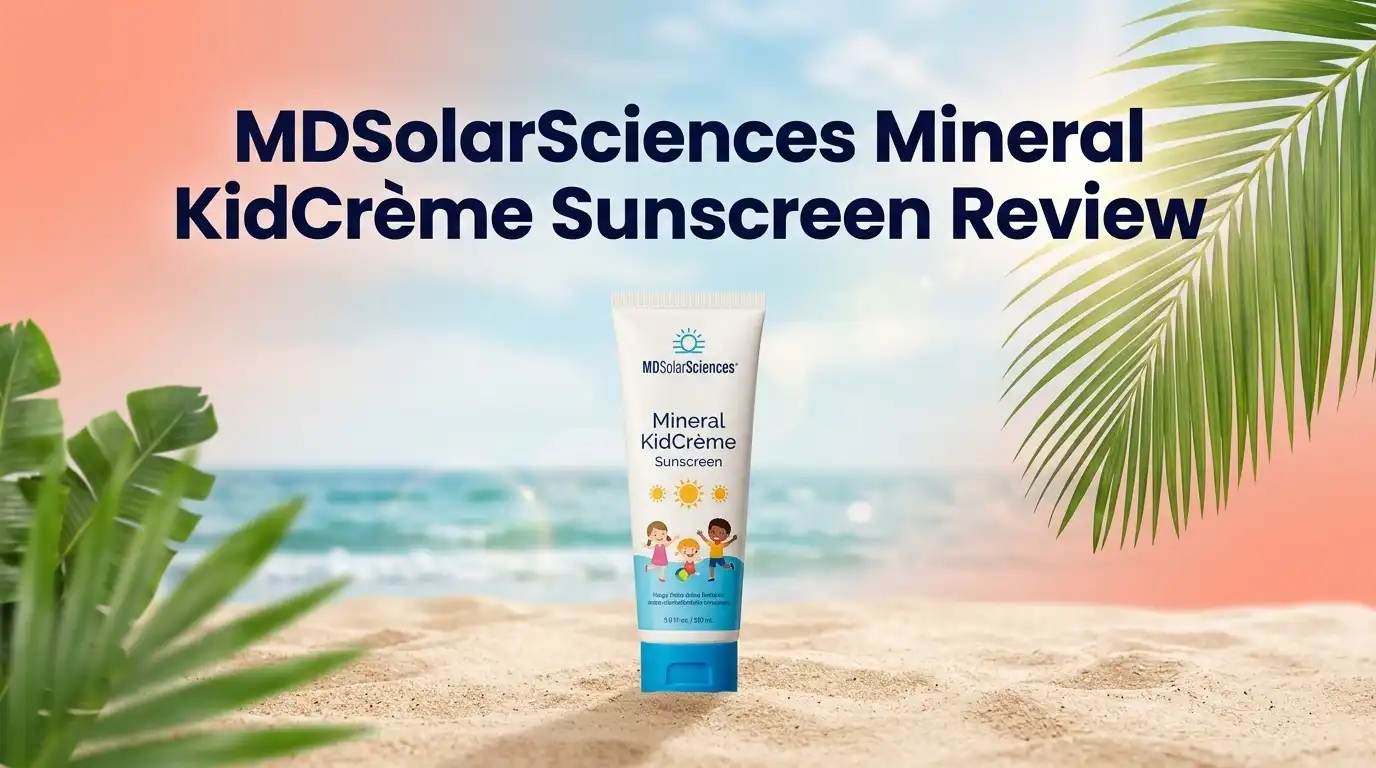
MDSolarSciences Mineral KidCrème Sunscreen Review 2026
Sunscreen shopping for kids feels like a small science project. You read labels, you compare zinc percentages, and you still end up with a white ghost child at the beach.
MDSolarSciences promises something different with its Mineral KidCrème, a dermatologist developed formula that claims to blend in fast and stay put in water.
I tested this sunscreen across a full summer with two kids, one of whom has dry, reactive skin that hates almost everything.
In A Nutshell:
- The formula is 100% mineral. The SPF 40 version uses zinc oxide at 17% and titanium dioxide at 2%. The newer SPF 50 version keeps the same mineral duo and adds squalane for moisture. No oxybenzone and no octinoxate anywhere.
- White cast is reduced, not erased. The cream blends far better than most zinc heavy kids sunscreens. On very deep skin tones, a faint cool tint still shows for a few minutes after rubbing.
- It does not sting eyes. This was the biggest win in my testing. My daughter cried through three other sunscreens last year. She did not cry through this one, even after swimming.
- Water resistance holds for 80 minutes. That matches the FDA maximum claim. It survived pool laps well but wore thin after towel drying, which is normal for any mineral cream.
- The price hurts. Expect roughly $40 to $45 for a 3.4 ounce tube at full retail. That is premium pricing for a small tube, and a family of four will burn through it fast.
- Best for sensitive and eczema prone skin. The fragrance free, alcohol free formula earned strong safety scores and caused zero reactions in my testing.
MDSolarSciences Mineral KidCrème Sunscreen

- Kid-Friendly Cream: Gentle mineral sunscreen with broad-spectrum SPF 50 protection designed for delicate and sensitive skin. The smooth, sheer formula is suitable for children 6 months and older and comfortable for the whole family.
- Shake, Slather & Go: Easy-to-apply kids sunscreen glides on smoothly without running or stinging eyes. The lightweight formula rubs in clear for comfortable broad-spectrum protection from head to toe.

Last update on 2026-08-30 / Affiliate links / Images from Amazon Product Advertising API Some of the links on this website are affiliate links, which means that at no additional cost to you, I earn a commission if you click through and make a purchase. I only recommend products and services that I believe will add value to my readers. Thank you for your support!
MDSolarSciences started as a dermatologist led brand focused on daily sun protection for people at higher skin cancer risk. The KidCrème is their gentlest formula, built for children aged six months and older.
The active ingredients do all the heavy lifting. Zinc oxide sits at 17% in the SPF 40 formula, which is a genuinely high load. Titanium dioxide adds another 2%. Together they cover UVB, UVA II, and UVA I almost evenly, which is why zinc based sunscreens rank so well for broad spectrum coverage.
The inactive list reads like a skincare product rather than a basic sunscreen. You get tetrahexyldecyl ascorbate, a stable oil soluble vitamin C. You also get green tea extract, CoQ10, vitamin E, pomegranate extract, and cranberry extract. These act as antioxidants that mop up free radicals the sunscreen filters cannot block.
Squalane appears near the end of the list. It is a lightweight moisturizer that matches the skin’s own sebum, so it softens without feeling heavy.
The base is silicone driven. Dimethicone, dimethicone crosspolymer, and silica create that smooth, almost powdery glide. This is the reason the cream spreads so much easier than old school zinc pastes.
The tube is 3.4 fluid ounces. It is fragrance free, alcohol free, hypoallergenic, non comedogenic, cruelty free, and reef safe by the brand’s own claim.
Unboxing Experience And First Impressions
The packaging arrives simple and clean. My tube shipped in a slim white carton with orange and blue accents, no plastic window, no wasteful filler. The carton felt sturdy enough that the tube arrived undented.
The tube itself is soft white plastic with a flip top cap. The cap clicks shut firmly, which matters more than you think. I have had beach bags ruined by sunscreen caps that pop open under a wet towel. This one stayed closed through an entire summer of abuse.
The first squeeze surprised me. I expected the thick, cement like texture that comes with 17% zinc. Instead the cream came out medium bodied and slightly slippery, closer to a face moisturizer than a beach sunscreen.
The color is off white with a barely warm undertone. There is a trace of iron oxide in the formula, which softens the stark chalk white you get from pure zinc products.
Smell test: almost nothing. There is a faint mineral scent, a little like clean clay. No coconut, no perfume, no chemical bite. My son, who complains about every scented product, did not comment once.
First application on a forearm took about 20 seconds to blend. The cast faded to a soft matte finish. My immediate thought was that this actually feels like a product designed for a face, not just a body slather.
Key Features And Specifications
Here is what the manufacturer claims, translated into plain language.
Broad spectrum protection comes from the mineral filter pair. The SPF 40 version protects against roughly 97.5% of UVB rays. The SPF 50 version pushes that to about 98%. The practical difference is small, so pick based on price and availability rather than the number.
Water resistance runs 80 minutes. That is the highest claim any sunscreen can legally make in the United States. After 80 minutes in water, you reapply. No exceptions.
Age range starts at six months. Babies younger than that should stay in shade and clothing, per pediatric guidance.
Fragrance free and alcohol free. Both matter enormously for kids with eczema or dermatitis, since fragrance is the single most common cause of contact reactions in children’s skincare.
Non nano zinc is the brand’s claim, meaning the particles stay on the skin surface rather than absorbing.
Hypoallergenic and non comedogenic. The formula scored a B rating from independent safety reviewers, with strong marks for UVA and UVB balance.
The antioxidant complex is the differentiator here. Most kids sunscreens skip antioxidants entirely to keep costs down. MDSolarSciences includes five of them. Whether a seven year old needs CoQ10 is debatable, but the vitamin C and vitamin E pairing does add measurable photoprotection on top of the mineral filters.
Shelf life runs about three years unopened, one season once opened.
Top 3 Alternatives for MDSolarSciences Mineral KidCrème Sunscreen

- MINERAL SUNSCREEN – Mineral sunscreen that offers broad spectrum protection.
- POWERFUL SPF 50 PROTECTION - Protects baby’s skin from 98% of UVB rays.
Last update on 2026-06-09 / Affiliate links / Images from Amazon Product Advertising API Some of the links on this website are affiliate links, which means that at no additional cost to you, I earn a commission if you click through and make a purchase. I only recommend products and services that I believe will add value to my readers. Thank you for your support!
Blue Lizard Baby Mineral Sunscreen SPF 50+

- Broad Spectrum SPF 50+ Protection: Provides effective UVA and UVB defense using mineral-based, non-nano zinc oxide (23.4%) for safe, reliable sun protection.
- Safe for Babies and Sensitive Skin: Pediatrician- and dermatologist-tested; free from biologically harmful chemicals such as oxybenzone, avobenzone, and UV chemical absorbers.
Last update on 2026-08-30 / Affiliate links / Images from Amazon Product Advertising API Some of the links on this website are affiliate links, which means that at no additional cost to you, I earn a commission if you click through and make a purchase. I only recommend products and services that I believe will add value to my readers. Thank you for your support!
Thinkbaby Safe Sunscreen SPF 50+

- Kid-Friendly SPF Protection: Gentle mineral sunscreen provides broad-spectrum UVA and UVB protection for delicate skin, making it ideal for outdoor play, family adventures, and everyday sun protection.
- Easy & Mess-Free Application: Convenient travel-friendly stick glides on smoothly for quick, hassle-free application and reapplication. Perfect for active kids and suitable for children 6 months and older.
Last update on 2026-08-30 / Affiliate links / Images from Amazon Product Advertising API Some of the links on this website are affiliate links, which means that at no additional cost to you, I earn a commission if you click through and make a purchase. I only recommend products and services that I believe will add value to my readers. Thank you for your support!
MDSolarSciences Mineral KidStick SPF 40
How The Formula Works On Skin
Mineral sunscreens get described as tiny mirrors that bounce light away. That description is mostly wrong. Research from 2016 showed that zinc oxide and titanium dioxide absorb most UV radiation, just like chemical filters do. They only reflect a small portion, mainly in the visible spectrum.
This matters for one practical reason. Mineral filters need to sit in an even, continuous layer to work. Patchy application means patchy protection. There is no chemical spreading effect to save you.
The silicone base is the clever part of this formula. Dimethicone and polyhydroxystearic acid disperse the zinc particles evenly so they do not clump. Polyhydroxystearic acid specifically helps reduce white cast and can slightly boost UV absorption.
Butyloctyl salicylate appears too. It is not a sunscreen filter itself but it improves spreadability and helps lift the SPF number.
There is one ingredient worth flagging. Polysilicone 15 is technically a chemical UVB filter, though it is not approved as an active in the United States and appears here in the inactive list. Parents who want absolutely zero synthetic filters should know this.
Once dry, the film feels velvety rather than greasy. The silica gives a slight mattifying effect. On humid days this was a genuine advantage, because sand stuck to my kids far less than with oil based mineral creams.
The antioxidants work underneath. They neutralize free radicals generated by whatever UV slips through.
Application Test On Real Kids
Theory is nice. Squirming children are the real test.
I applied this to two kids, ages four and eight, over roughly 30 separate outings. Here is what happened.
Blend time averaged 25 to 40 seconds per limb. That is fast for a mineral product. Compare that to thicker zinc pastes that need a full minute of massaging plus a waiting period.
The cream needs warm hands. Straight from an air conditioned house, it drags a little. Rubbing it between your palms first fixes this completely.
Coverage on the face went better than expected. It did not pill under my son’s eyes, which is where most mineral sunscreens fail. It also did not migrate into the eyes during sweaty soccer practice, and that alone changed our morning routine.
My four year old has fair skin with pink undertones. On her, the finish went essentially invisible after a minute.
I also tested it on my niece, who has deep brown skin. Here the review has to be honest. A grey cool cast stayed visible for two to three minutes, then softened to a faint ashy sheen that never fully disappeared in photos. It is better than most, but it is not invisible.
Amount matters. A shot glass worth covers a small child’s body properly. Skimping cuts your real SPF drastically.
Water Resistance And Beach Performance
We ran this through pool days, ocean days, and one very hot splash pad afternoon.
In still pool water, the film held well. After 45 minutes of continuous swimming, I could still see a faint sheen on my son’s shoulders. No redness developed afterward.
Ocean testing was tougher. Salt water plus sand abrasion wore the film thinner. At the 80 minute mark, protection was clearly reduced on high friction areas like shoulders and the tops of feet.
Towel drying is the real enemy. One vigorous towel rub removes a shocking amount of any mineral sunscreen. This product is no exception. I reapplied after every towel session, and I would tell any parent to do the same.
Sweat resistance impressed me more. During a 90 degree soccer morning, the cream stayed put and did not run into eyes. My son finished the game without rubbing his face once. For anyone who has watched a child scream through sunscreen sting, that is the headline benefit.
Reapplication over an existing layer works cleanly. It does not roll or pill on top of itself, which some silicone heavy sunscreens do.
Verdict on water performance: solid, reliable, and honest about its 80 minute limit. It does not overpromise.
Skin Safety For Sensitive And Eczema Prone Skin
This is where the KidCrème earns its price.
My older son has mild eczema on the backs of his knees and inner elbows. Chemical sunscreens with avobenzone consistently trigger flushing and itching for him. Scented mineral formulas irritate the flare areas.
He used this cream across a full season with zero reactions. No stinging on application, no redness the next morning, no itching complaints.
The reasons are structural. There is no fragrance and no essential oils. There is no alcohol. There is no chemical filter that penetrates the skin barrier. Zinc oxide itself acts as a skin protectant and anti irritant, which is exactly why it appears in diaper rash creams.
The dimethicone base adds an occlusive layer that reduces water loss from already dry skin. Squalane supports that.
Independent safety databases rate this product favorably, with a low hazard score and strong UVA and UVB balance.
One caution. Hypoallergenic is a marketing term, not a regulated standard. Any child can react to any ingredient. Patch test a small area on the inner forearm and wait 24 hours before a full body application.
Also worth noting: this is not a medical product. Children with severe eczema or diagnosed photosensitivity should get a pediatric dermatologist’s input rather than relying on a label claim.
What This Sunscreen Does Not Do Well
Every honest review needs this section. Here are the genuine weaknesses.
The price is steep. At roughly $40 to $45 for 3.4 ounces, this costs three to four times what mainstream kids sunscreens cost per ounce. A family applying properly will empty a tube in two or three beach days. That math is painful.
The tube is too small. There is no family size option in the crème format. For a product meant for the whole family, that is a design gap.
White cast persists on deep skin tones. The brand’s “no white cast” messaging overstates reality. It is improved, not solved.
It is not a spray. Wrangling a toddler for a full cream application takes patience. Parents who want speed will find this frustrating.
The silicone finish feels odd to some people. A few adults in my house described it as slippery or slightly rubbery. It is a texture preference, not a flaw, but you should know.
Availability is inconsistent. Stock rotates between the SPF 40 and SPF 50 versions, and third party listings sometimes carry inflated prices.
It transfers to clothing. White smudges showed on my daughter’s navy swim shirt. They washed out, but they showed.
None of these are dealbreakers for the right buyer. They are simply the honest tradeoffs.
Pros And Cons
Pros
- High zinc oxide load at 17% delivers genuine broad spectrum coverage across UVB, UVA II, and UVA I.
- Does not sting eyes, even during heavy sweating or swimming. This is the standout benefit for young children.
- Blends faster than most mineral creams, thanks to the silicone and dispersant base.
- Fragrance free, alcohol free, and gentle for eczema prone and reactive skin.
- Antioxidant complex included, with vitamin C, vitamin E, green tea, and CoQ10 adding a second layer of defense.
- Water resistant for the full 80 minutes, the maximum legal claim.
- Squalane keeps skin soft instead of leaving the tight, dry feel many mineral sunscreens create.
- Reef safe formula with no oxybenzone or octinoxate.
- Works for adults too, especially on the face, so nothing goes to waste.
Cons
- Expensive per ounce compared to drugstore mineral options.
- Small 3.4 ounce tube empties quickly for a full family.
- Visible cast on deeper skin tones despite marketing claims.
- Requires warm hands for easy spreading on cool mornings.
- Transfers onto fabric and leaves temporary white marks.
- No family size or spray version of this specific crème.
- Contains polysilicone 15, which purists may not want.
Price And Value For Money
Let us talk numbers honestly.
The SPF 50 KidCrème lists around $45 for 3.4 ounces at the brand’s own store. Retail partners and marketplace listings often run lower, sometimes in the low thirties. The older SPF 40 version usually costs less when you find it.
That works out to roughly $12 to $13 per ounce. A mainstream mineral kids sunscreen costs about $4 to $7 per ounce.
So is it worth triple the price? It depends entirely on your situation.
If your child has reactive skin, the answer is yes. One tube that your child tolerates beats three cheap tubes sitting unused because they sting or itch. The cost of a bad reaction, in tears and in ruined vacation days, is higher than the price gap.
If your child has typical skin and no complaints about drugstore sunscreen, the answer is probably no. Blue Lizard and Thinkbaby deliver comparable zinc protection for far less money.
There is a middle path worth considering. Use the KidCrème for faces, ears, and shoulders, which are the highest risk areas. Use a cheaper mineral option for arms, legs, and backs. This stretches one tube across an entire season and keeps the gentle formula where sensitivity matters most.
Watch for bundle deals with the KidStick. Those often cut the effective cost per ounce meaningfully.
How It Compares To Other Kids Mineral Sunscreens
Against Blue Lizard Baby, the KidCrème wins on texture and antioxidant content. Blue Lizard wins clearly on price and on tube size. Blue Lizard also has the color changing cap that alerts you to UV exposure, which kids find genuinely fun. Blue Lizard leaves a heavier cast.
Against Thinkbaby SPF 50+, the comparison is closer. Thinkbaby uses 20% non nano zinc and has a loyal following. Its texture is thicker and it takes longer to blend. Thinkbaby costs considerably less. The KidCrème feels more refined, especially on faces.
Against the MDSolarSciences KidStick, the choice is about format. The stick is easier for faces, ears, and quick touch ups on a moving child. It uses a lower zinc concentration and adds shea butter. Most parents I know end up owning both, using the stick for reapplication and the crème for the initial coat.
Against drugstore chemical sunscreens, the KidCrème wins on gentleness and loses on convenience and price.
The honest positioning: this is a premium, dermatology adjacent product. It competes with medical grade sunscreens more than with beach aisle brands. If you already buy EltaMD or similar for yourself, this will feel familiar and reasonable.
Who Should Buy It And Who Should Skip It
Buy it if your child has eczema, dermatitis, rosacea prone skin, or a history of reacting to sunscreens. The gentleness is real and it is the main reason to pay the premium.
Buy it if your child screams about sunscreen stinging their eyes. This formula solved that problem in my household completely.
Buy it if you want a face sunscreen that works for both kids and adults. It layers well and does not pill.
Buy it if you have a child with a family history of skin cancer or a large number of moles. High zinc content and antioxidant support make sense for higher risk situations.
Skip it if you need to cover multiple children daily and budget matters. The cost per application will frustrate you.
Skip it if your child has deep skin tone and any visible cast is a dealbreaker. Test a tinted mineral option instead.
Skip it if you strongly prefer sprays or if you have a child who will not sit still for a cream application.
Skip it if your current sunscreen already works fine. There is no reason to fix something that is not broken. Consistent use of an affordable sunscreen beats occasional use of an expensive one every single time.
Tips To Get The Best Results
Apply 15 minutes before going outside. Mineral filters work immediately in theory, but the film needs time to set so it does not rub off on clothes.
Warm the cream between your palms first. This single step cuts blending time in half.
Use enough. One teaspoon covers a small child’s face and neck. A shot glass covers the body. Underapplying is the most common mistake and it slashes real world SPF dramatically.
Work in sections. Do one arm completely, then move on. Trying to dot the whole body then rub creates uneven patches.
Reapply every two hours and immediately after towel drying. Set a phone timer if you forget, because everyone forgets.
Do not skip ears, the tops of feet, the back of the neck, and the part in the hair. These are the spots that burn on my kids every single time I rush.
Store the tube out of direct sun. Heat degrades sunscreen faster than time does. A cooler bag or a shaded corner of the beach bag works.
Layer the stick over the crème for reapplication on faces. It is faster and less messy than a second cream coat.
Finally, remember that sunscreen is one tool. Shade, hats, and UPF clothing do more heavy lifting than any bottle, especially between 10am and 4pm.
Final Verdict
- Kid-Friendly Cream: Gentle mineral sunscreen with broad-spectrum SPF 50 protection designed for delicate and sensitive skin. The smooth, sheer formula is suitable for children 6 months and older and comfortable for the whole family.
- Shake, Slather & Go: Easy-to-apply kids sunscreen glides on smoothly without running or stinging eyes. The lightweight formula rubs in clear for comfortable broad-spectrum protection from head to toe.
Last update on 2026-08-30 / Affiliate links / Images from Amazon Product Advertising API Some of the links on this website are affiliate links, which means that at no additional cost to you, I earn a commission if you click through and make a purchase. I only recommend products and services that I believe will add value to my readers. Thank you for your support!
The MDSolarSciences Mineral KidCrème is a genuinely good sunscreen with one significant catch.
The formula does what a kids mineral sunscreen should do. It protects broadly, it stays gentle, it does not sting eyes, and it holds up through 80 minutes of water. The antioxidant additions are a real bonus rather than label decoration. The texture is among the best I have used in a high zinc product.
The catch is the price. You are paying roughly triple the drugstore rate for a small tube. For families with typical skin and typical budgets, that is hard to justify when Blue Lizard and Thinkbaby exist.
My rating: 4.2 out of 5.
I would recommend it without hesitation to parents of sensitive skinned children, to families dealing with sunscreen refusal because of eye stinging, and to anyone who wants one product that works for kids and adults alike.
I would point everyone else toward a cheaper mineral option and suggest they spend the savings on a good rash guard and a wide brim hat.
The best sunscreen is the one your child will let you apply every single day. If this is that sunscreen for your family, the price stops being the point.
FAQs
Is MDSolarSciences Mineral KidCrème safe for babies?
It is labeled for children six months and older. Infants younger than six months should be kept in shade and covered with clothing rather than treated with sunscreen. Ask your pediatrician before applying any sunscreen to a young infant. This is general information, not medical advice.
Does it leave a white cast?
Less than most mineral sunscreens, but not zero. On fair and medium skin, the cast fades within a minute or two. On deep skin tones, a faint cool grey sheen remains visible. Warming the product in your hands and applying thin layers reduces it noticeably.
How often should I reapply it?
Every two hours during sun exposure, and immediately after swimming, heavy sweating, or towel drying. The 80 minute water resistance claim is a maximum, not a guarantee, and towel friction removes the film quickly.
Can adults use this sunscreen?
Yes. Many adults prefer it as a face sunscreen because it is fragrance free and does not sting eyes. It works well under makeup thanks to the silky silicone finish. The formula is not restricted to children in any way.
Is it reef safe?
The brand markets it as reef safe. It contains no oxybenzone and no octinoxate, the two filters most commonly restricted in coral reef regions. Mineral zinc and titanium dioxide filters are generally the accepted choice for reef sensitive areas.
What is the difference between the SPF 40 and SPF 50 versions?
Both use zinc oxide and titanium dioxide. The SPF 50 version is the current formula and blocks slightly more UVB, about 98% versus 97.5%. The SPF 50 also highlights squalane for added moisture. Real world protection differences are small when either is applied properly.
Does it clog pores?
The formula is labeled non comedogenic and contains no heavy oils. Zinc oxide has a very low comedogenic rating. Teens with acne prone skin generally tolerate it well, though individual results vary.
How long does one tube last?
The 3.4 ounce tube covers roughly six to eight full body applications for a small child when used at the correct amount. Heavy beach users will finish a tube in a few outings. Face only use stretches it across an entire season.

Hi, I’m Sienna Marie, and I’m passionate about finding products that truly make a difference in everyday life. Through my blog at Lija.blog, I share honest, first-person reviews of Amazon products spanning fashion, beauty, supplements, and beyond. I believe in testing products myself before recommending them, giving you the real story behind each purchase.